Birds Without Wings
Literature & Fiction, Louis de Bernieres
Birds Without Wings Louis de Bernieres pdf español - Un grand auteur, Louis de Bernieres a écrit une belle Birds Without Wings livre. Ne vous inquiétez pas, le sujet de Birds Without Wings est très intéressant à lire page par page. Le livre a pages 578. Je suis sûr que vous ne vous sentirez pas ennuyeux à lire. Ce livre étonnant est publié par une grande fabrication, Vintage Digital. La lecture de la Birds Without Wings fera plus de plaisir dans votre vie. Vous pourrez profiter de l'idée derrière le contenu. Télécharger Birds Without Wings bientôt à votre ordinateur portable facilement.. Si vous avez décidé de trouver ou lire ce livre, ci-dessous sont des informations sur le détail de Birds Without Wings pour votre référence.
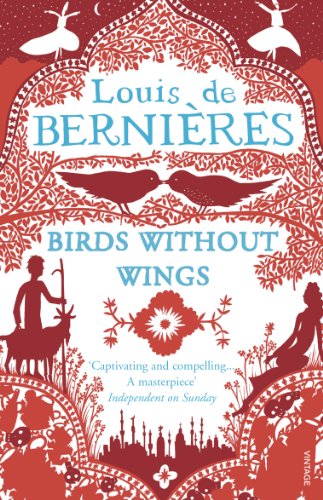
de Louis de Bernieres
5 étoiles sur 5 (87 Commentaires client)
Nom de fichier : birds-without-wings.pdf
La taille du fichier : 24.94 MB
When war is declared and the outside world intrudes, the twin scourges of religion and nationalism lead to forced marches and massacres, and the peaceful fabric of life is destroyed. Birds Without Wings is a novel about the personal and political costs of war, and about love: between men and women; between friends; between those who are driven to be enemies; and between Philothei, a Christian girl of legendary beauty, and Ibrahim the Goatherd, who has courted her since infancy. Epic in sweep, intoxicating in its sensual detail, it is an enchanting masterpiece.Set against the backdrop of the collapsing Ottoman Empire, the Gallipoli campaign and the subsequent bitter struggle between Greeks and Turks, Birds Without Wings traces the fortunes of one small community in south-west Anatolia - a town in which Christian and Muslim lives and traditions have co-existed peacefully for centuries.
When war is declared and the outside world intrudes, the twin scourges of religion and nationalism lead to forced marches and massacres, and the peaceful fabric of life is destroyed. Birds Without Wings is a novel about the personal and political costs of war, and about love: between men and women; between friends; between those who are driven to be enemies; and between Philothei, a Christian girl of legendary beauty, and Ibrahim the Goatherd, who has courted her since infancy. Epic in sweep, intoxicating in its sensual detail, it is an enchanting masterpiece.Rang parmi les ventes Amazon: #94878 dans eBooksPublié le: 2011-11-30Sorti le: 2011-11-30Format: Ebook KindlePrésentation de l'éditeurSet against the backdrop of the collapsing Ottoman Empire, the Gallipoli campaign and the subsequent bitter struggle between Greeks and Turks, Birds Without Wings traces the fortunes of one small community in south-west Anatolia - a town in which Christian and Muslim lives and traditions have co-existed peacefully for centuries. When war is declared and the outside world intrudes, the twin scourges of religion and nationalism lead to forced marches and massacres, and the peaceful fabric of life is destroyed. Birds Without Wings is a novel about the personal and political costs of war, and about love: between men and women; between friends; between those who are driven to be enemies; and between Philothei, a Christian girl of legendary beauty, and Ibrahim the Goatherd, who has courted her since infancy. Epic in sweep, intoxicating in its sensual detail, it is an enchanting masterpiece.ExtraitChapter 1 The Prologue of Iskander the PotterThe people who remained in this place have often asked themselves why it was that Ibrahim went mad. I am the only one who knows, but I have always been committed to silence, because he begged me to respect his grief, or, as he also put it, to take pity upon his guilt. Now that he is mad, and the sun has long since dried the rain that washed away the blood upon the rocks, and there is almost no one left who recalls the lovely Philothei, it seems to me that no one would be betrayed if finally the truth of it were known. With us there has been so much blood that in restrospect none of it seems believable, and it cannot matter much if finally I tell of the last misfortune that fell upon Philothei, sweet-natured, Christian, vain and beautiful.There comes a point in life where each one of us who survives begins to feel like a ghost that has forgotten to die at the right time, and certainly most of us were more amusing when we were young. It seems that age folds the heart in on itself. Some of us walk detached, dreaming on the past, and some of us realise that we have lost the trick of standing in the sun. For many of us the thought of the future is a cause for irritation rather than optimism, as if we have had enough of new things, and wish only for the long sleep that rounds the edges of our lives. I feel this weariness myself.We are in any case a serious people here. Life was merrier when the Christians were still among us, not least because almost every one of their days was the feast of some saint. Little work was done, it seemed, but at least their revelry was infectious. Our religion makes us grave and thoughtful, dignified and melancholy, whereas theirs did not exact much discipline. Perhaps it was something to do with the wine. For them it was a precious and sacred thing, because they thought it was something like the blood of God, whereas for us the pleasure of it has always been soured since the Prophet of God forbad it. Peace be upon him, but I have often wished that he had decided otherwise. We drink, but we dislike ourselves in drinking. Sometimes we did drink with our Christians, and caught their high spirits in the same way that one catches malaria from the chill night air, but, left on our own now, there is a sadness seeping out of the stones of this half-deserted town.Ibrahim the Mad was one of our most entertaining when he was young. It was said that there was a smile at the corners of his lips from the moment of his birth, and from early boyhood he was a specialist in inappropriate interjections. To be precise, he perfected a repertoire of bleats that exactly mimicked the stupid comments of a goat in all its various states of mind; a goat that is surprised, a goat that is looking for its kid, a goat that is protesting, a goat that is hungry, a goat that is perplexed, a goat that is in rut. His most popular bleat, however, was that of a goat that has nothing to say. This bleat was the perfect parody of unintelligence, empty-headedness, inanity and harmlessness. If you want to know what it sounded like, just go up past the ancient tombs to where the limepit is. It is in the wild ground near there that Ibrahim the Mad still watches the goats, even though he is no longer sane. You should beware of his great dog. It is a very fine animal that takes each goat back to its owner every evening, without Ibrahim the Mad having to do anything at all, but it is a somewhat ready-fanged dog that recognises a stranger straight away by the smell. If you cannot find Ibrahim there, then listen for the sound of the kaval, and follow it. He blows it so sadly that it makes you stand still and go into mourning. He does not bleat himself any more, but listens to the goats as they wander from shrub to shrub, and you will soon recognise the bleat of a goat with nothing to say.Ibrahim used to do it quite suddenly in the middle of a conversation, or at a solemn moment in a ceremony, and when he was a small boy his father used to beat him for it. One day he even interrupted the imam, Abdulhamid Hodja, who was making some interminable point about the law, which was one of his habits, may he rest in paradise. This was under the plane trees where the old men sit in the meydan. Anyway, Ibrahim crept up behind a tree — he was about eight years old — and bleated quite suddenly when everyone else was listening quietly and respectfully. There was a shocked silence, and then Ibrahim giggled and ran away. The men looked at each other, and Ibrahim’s father leapt to his feet, his face flushed with anger and shame. But Abdulhamid was a good-natured man who was naturally dignified enough not to have to be concerned about offences against his dignity, and he put his hand on the other’s sleeve. “Don’t strike him,” he said. “I was bleating myself, and now someone else should have the chance to speak.” Ibrahim’s father was called Ali the Broken-Nosed.The men were puzzled by the imam’s tolerance of such disrespect, but the word spread that the imam considered that there was something providential in the irreverence of the boy, so from then onwards his mischief was accepted as one of the normal hazards of life. Back in those days Ibrahim was a friend of my son, Karatavuk, and I can truly say that he was not mad at all, he was merely framed by God in a comical way. If you want to see him as he is now, you don’t have to go up to the tombs, now that I come to think of it. Just wait until he returns with the goats, and the great dog delivers them home for the night. Ibrahim the Mad knows the name of each goat, but apart from that his head is empty enough to rent.They say that, for a madman, every day is a holiday, but they also say that insanity has seventy gates. It is true that many of the mad are happy, as you can see by the idiots of this town who sit on the walls and grin and piss themselves, but I know that the gate through which Ibrahim travelled was the gate of unconquerable sorrow, and that his mind remains a cataract of grief. I think that back in those days many of us were maddened by hatred because of the war with the Greeks, and in all honesty I include myself, but Ibrahim was the one among us whose mind was disengaged by love.Ibrahim blamed himself, and if I had been one of her brothers or one of her other relatives, I would have come back from exile and killed him. The peculiar thing is, however, that nothing would have happened to Philothei at all, if other things had not been happening in the great world. So it is my opinion that the blame belongs more widely, not only to Ibrahim but to all of us who lived in this place, as well as to those in other parts who were bloodthirsty and ambitious.In those days we came to hear of many other countries that had never figured in our lives before. It was a rapid education, and many of us are still confused. We knew that our Christians were sometimes called “Greeks,” although we often called them “dogs” or “infidels,” but in a manner that was a formality, or said with a smile, just as were their deprecatory terms for us. They would call us “Turks” in order to insult us, at the time when we called ourselves “Ottomans” or “Osmanlis.” Later on it turned out that we really are “Turks,” and we became proud of it, as one does of new boots that are uncomfortable at first, but then settle into the feet and look exceedingly smart. Be that as it may, one day we discovered that there actually existed a country called “Greece” that wanted to own this place, and do away with us, and take away our land. We knew of Russians before, because of other wars, but who were these Italians? Who were these other Frankish people? Suddenly we heard of people called “Germans,” and people called “French,” and of a place called Britain that had governed half the world without us knowing of it, but it was never explained to us why they had chosen to come and bring us hardship, starvation, bloodshed and lamentation, why they played with us and martyred our tranquillity.I blame these Frankish peoples, and I blame potentates and pashas whose names I will probably never know, and I blame men of God of both faiths, and I blame all those who gave their soldiers permission to behave like wolves and told them that it was necessary and noble. Because of what I accidentally did to my son Karatavuk, I was in my own small way one of these wolves, and I am now burned up by shame. In the long years of those wars here were too many who learned how to make their hearts boil with hatred, how to betray their neighbours, how to violate women, how to steal and dispossess, how to call upon God when they did the Devil’s work, how to enrage and embitter themselves, and how to commit outrages even against children. Much of what was done was simply in revenge for identical atrocities, but I tell you now that even if guilt were a coat of sable, and the ground were deep in snow, I would rather freeze than wear it.But I do not blame merely myself, or the powerful, or my fellow Anatolians, or the savage Greeks. I also blame mischance. Destiny caresses the few, but molests the many, and finally every sheep will hang by its own foot on the butcher’s hook, just as every grain of wheat arrives at the millstone, no matter where it grew.It is strange indeed that if you should wish me to tell you how one young Christian woman died by accident in this unremarkable place, you must also be told of great men like Mustafa Kemal, and little men like me, and you must also be told the story of upheavals and wars. There is, it seems, a natural perversity in the nature of fate, just as there is a natural perversity in ourselves.I wonder sometimes whether there are times when God sleeps or averts His eyes, or if there is a divine perversity. Who knows why one day a man drowns because a deep hole has been carved in the fording place of a river,...From Publishers WeeklyIt's been nearly a decade since Captain Corelli's Mandolin became a word-of-mouth bestseller (and then a major feature film), and devotees will eagerly dig into de Bernières' sweeping historical follow-up. This time the setting is the small Anatolian town of Eskibahçe, in the waning days of the Ottoman Empire. The large cast of characters of intermixed Turkish, Greek and Armenian descent includes breathtakingly lovely Philothei, a Christian girl, and her beloved Ibrahim, the childhood friend and Muslim to whom she is betrothed. The narrative immediately sets up Philothei's death and Ibrahim's madness as the focal tragedy caused by the sweep of history—but this is a bit of a red herring. Various first-person voices alternate in brief chapters with an authorial perspective that details the interactions of the town's residents as the region is torn apart by war; a parallel set of chapters follows the life of Kemal Atatürk, who established Turkey as a modern, secular country. The necessary historical information can be tedious, and stilted prose renders some key characters (like Philothei) one-dimensional. But when de Bernières relaxes his grip on the grand sweep of history—as he does with the lively and affecting anecdotes involving the Muslim landlord Rustem Bey and his wife and mistress—the results resonate with the very personal consequences that large-scale change can effect. Though some readers may balk at the novel's sheer heft, the reward is an effective and moving portrayal of a way of life—and lives—that might, if not for Bernières's careful exposition and imagination, be lost to memory forever. Copyright © Reed Business Information, a division of Reed Elsevier Inc. All rights reserved.Vous trouverez ci-dessous quelques critiques les plus utiles sur Birds Without Wings. Vous pouvez considérer cela avant de décider d'acheter / lire ce livre.
0 internautes sur 0 ont trouvé ce commentaire utile.Long' but worth itPar Christopher LongmoreAn excellent insight into a muderous civil war' the consequences of which live on to-day. The actual village is near Fethiye. Well worth a visit despite the camels and the quads
Si vous avez un intérêt pour Birds Without Wings, vous pouvez également lire un livre similaire tel que cc The Ministry of Utmost Happiness: Longlisted for the Man Booker Prize 2017, Days Without End (English Edition), Captain Corelli's Mandolin, The Dust that Falls from Dreams, A Legacy of Spies, Notwithstanding: Stories from an English Village, The Great Fortune: The Balkan Trilogy 1, All the Light We Cannot See, Burnt Shadows

No comments:
Post a Comment